
The show platform for county shows
The ready-built alternative to building your own — offline-first, vendor-ready, and proven, for a fraction of an in-house build.
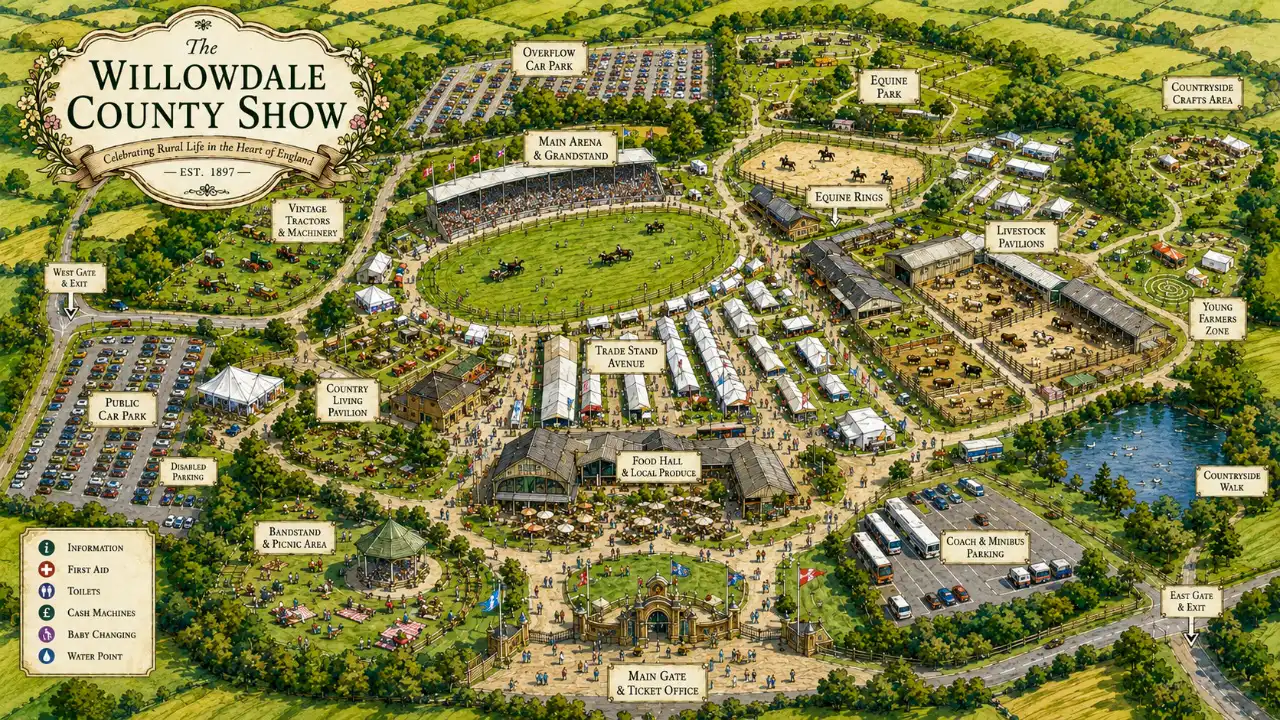
At county scale the question is no longer whether visitors want the show on their phones — they expect it. The question is how: commission an app of your own, or use a platform built for exactly this. The flagship shows have had commissioned apps for years, and the same weaknesses recur across them — maps that fail on showground signal, vendor sections nobody fills, and schedules kept thin. Those are the hard parts, and they're where a one-off build struggles.
Offline-first as standard: map, pins and full schedule keep working with no signal — the single most common failure of commissioned show apps.
The commercial machinery is built in: traders and sponsors run their own listings, and you set what they pay and keep all of it.
Deep schedules, imported from your existing programme rather than re-typed — visitors can plan their whole day.
No build cost, no maintenance retainer, no agency relationship to manage. Live in weeks, not seasons.
Go deeper: how the showground map builder works — satellite tracing, automatic illustration, and a map visitors can use offline.
Commissioned show apps commonly cost five figures to build and carry an annual maintenance commitment — and the hardest parts are invisible in the demo.
Read the honest comparison: building your own show app vs ShowDayGuide →Run at county scale from one dashboard
Map builder, schedule importer, vendor and sponsor management, announcements and analytics in one place — with your whole team invited at no extra charge and a readiness checklist that shows exactly what's left before publish. This is the operations surface a commissioned app never comes with.
Evidence, not estimates
Counted visitor activity — page views, map usage, listing engagement — surfaced to you and to your commercial partners. At county scale this is the difference between renewing sponsors on goodwill and renewing them on numbers, at fees the numbers justify.
The case at county scale, in your numbers
At your size the partner side stops being a nice-to-have: dozens of trade stands, sponsors who expect proof, and real advertising inventory. The calculator starts at a county-scale show — set it to yours.
The County licence, in full
£1,499 a year, everything included — a fraction of a build quote, live in weeks.
Every band and every partner fee, side by side: the full price table →
Create your showFrequently asked questions
Should a show our size build its own app?
Only if your organisation runs events year-round with in-house digital staff and a multi-year software budget. For an annual show, a bespoke build means five-figure costs, months of lead time and a permanent maintenance commitment — usually to deliver less than a ready-built platform provides immediately. We've written an honest comparison covering costs, offline reliability and maintenance.
Can it handle a county-scale schedule?
Yes — the schedule is built for full multi-ring, multi-day programmes with sections, classes and timings, and it can be imported from your existing programme document rather than entered by hand. Visitors browse it, search it, and set reminders from it.
What makes the offline claim different from other show apps?
It's built in from the start rather than added later. The map, pins and schedule are stored on the visitor's phone, so they keep working with no signal at all. Apps built online-first — including many commissioned native show apps — fail in exactly those conditions.
How does the commercial side work at our scale?
Traders, sponsors and advertisers manage their own listings through invitation links that carry your show's name. You pay a small fee for each listing; what you charge your partners is your business, and you keep all of it. At county scale, a page every visitor sees — with the numbers to prove it afterwards — is what lets a show charge more for it.
Does it work alongside the entries system we already use?
Yes. ShowDayGuide is the visitor side of your show — the map, the live schedule, announcements, and your partners' pages — and it runs alongside whatever you use for entries today. Nothing about how exhibitors enter has to change.